






Help
Ethics approval is required for research projects involving human participants, and research activities cannot commence until ethics approval has been provided in writing. Human Research is conducted with or about people, their data, and/or their tissue. In Australia the National Statement on Ethical Conduct in Human Research 2023 (National Statement), is in place to promote ethical human research.
Templates can be accessed at the dropdown menu at the top of this page Help>Templates.
Establish a Profile within EthicsRM
To create a profile within EthicsRM, select the green 'new user' button on the login page.
For all TUA researchers (staff and HDR candidates) the profile is to be based on a TUA email address.
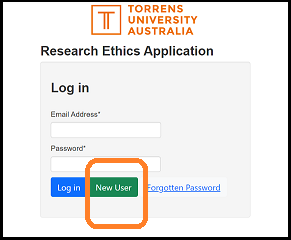
The login page is linked here, or can be accessed from this page at the top black banner 
Create and Access a Project
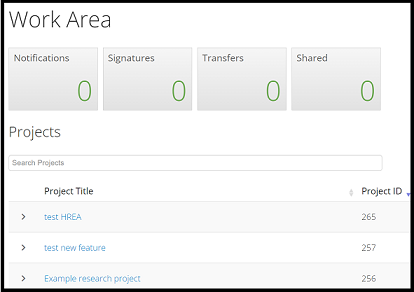
Once logged in using your established profile, you will be taken to the 'Work Area'.
To create a project select the 'create project' icon:

Within the Work Area, all research projects created will be listed by the Project Title and the unique Project ID (ethics application number). To access a previously created project, select the project title hyperlink in blue:
Project Team
At the 'Project Team' section, all research project team members are to be listed.
The position of 'Principal Investigator' has overall responsibility for the ethical management of the research project, and must be a TUA researcher. The position can be allocated by selecting 'Principal Investigator' from the dropdown box at Q1.9.10.

HDR research projects allocate the following positions at Q1.9.10:
- the Principal Supervisor's position is 'Principal Investigator', and
- the HDR Candidate is 'Investigator/Researcher'.
In summary the naming conventions and definitions at Q1.9.10:
- ASSOCIATE/ASSISTANT/SUB/CO-INVESTIGATOR/RESEARCHER: All researchers, apart from the Principal Investigator and the HDR Candidate.
- CHIEF INVESTIGATOR/RESEARCHER: Not used
- CO-ORDINATING PRINCIPAL INVESTIGATOR/RESEARCHER: Coordinating PI for multi-site projects.
- INVESTIGATOR/RESEARCHER: HDR Candidate
- LEAD INVESTIGATOR/RESEARCHER: Not used
- OTHER: if required for RA roles
- PRINCIPAL INVESTIGATOR: Key researcher responsible for the project, allocated to a TUA staff member.
Share an Application
All research team members must have an established profile within EthicsRM.
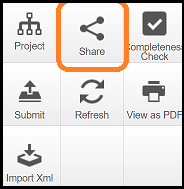
To share an ethics application with a team member, select the 'share' icon:
Enter the EthicsRM profile email address for the team member, and select the appropriate access from the available list:
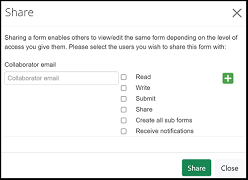
Select the 'Share' green button to complete.
Supporting Documentation
The supporting document to be attached (as part of an ethics application) include, but are not limited to:
At Q4.1
- Project Description
At Q4.2
- (1) TUA Research Endorsement: Coordinated by the Principal Investigator.
- (2) Curriculum Vitae (CV): CV documents for each team member.
- (3) Participant Recruitment: All participant recruitment documentation.
- (4) Participant Information & Consent Form (PICF): PICF in the template format.
- (5) Data Collection: All data collection instruments.
- (6) Authorisations and Permissions: if required, site specific or organisational.
Templates and guides can be accessed at the Help>Templates dropdown at the top of this page.
Declaration Page
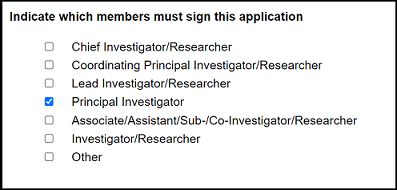
The declaration page is delegated to the Principal Investigator (for HDR research projects, this position is held by the Principal Supervisor).
Reviewer Comments
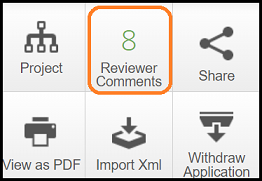
When an ethics application has been reverted, the comments can be accessed by selecting the 'Reviewer Comments' icon:
Data Collection: Personal Information
At Section 3 of the ethics application, researchers are asked to indicate the type of data they are collecting and using for the research project, and whether the information is categorised as personal, sensitive or health.
The concept of ‘personal information’ is broad under the Australian Privacy Act 1988. The guidance and examples provided by the Office of the Australian Information Commissioner may be helpful in understanding personal information and the types of personal information (such as sensitive information).
HREA Information (Source: NHMRC)
Further information about the HREA
Further information about the Human Research Ethics Application (HREA) form and help resources are available on the NHMRC's website.
Human Research Ethics Committees
Human Research Ethics Committee (HRECs) play a central role in the Australian system of ethics oversight of human research. HRECs review research proposals involving human participants to ensure that they are ethically acceptable and in accordance with relevant standards and guidelines.
There are approximately 180 HRECs in institutions and organisations across Australia. Many other countries have similar systems.
In undertaking this role, HRECs are guided by relevant standards. Standards include those in the National Statement on Ethical Conduct in Human Research (the National Statement) issued by NHMRC.
The National Statement sets out the requirements for the composition of an HREC and the relevant ethical principles and values by which research should be designed and conducted and to which HRECs should refer when reviewing research proposals. It also identifies requirements and responsibilities for:
- Institutions/organisations in establishing HRECs
- researchers in submitting research proposals to HRECs
- HRECs in considering and reaching decisions regarding these proposals and in monitoring the conduct of approved research.
In some circumstances HRECs charge fees for considering research application.
Further information about HRECs is available on NHMRC's website.
National Statement on Ethical Conduct in Human Research
The latest version of the National Statement on Ethical Conduct in Human Research (the National Statement) is available on NHMRC's website.
The National Statement consists of a series of guidelines made in accordance with the National Health and Medical Research Council Act 1992. It is intended for use by:
- any researcher conducting research with human participants;
- any member of an ethics review body reviewing that research;
- those involved in research governance; and
- potential research participants.
The National Statement is developed jointly by the National Health and Medical Research Council, the Australian Research Council and Universities Australia.
Compliance with the National Statement is a prerequisite for receipt of NHMRC funding.
Privacy Act Definition of Personal, Sensitive and Health Information
- Personal information is defined in the Privacy Act 1988 (Cth) as information or an opinion about an identified individual, or an individual who is reasonably identifiable:
a) whether the information or opinion is true or not; and
b) whether the information or opinion is recorded in a material form or not.
- Sensitive information is defined in the Privacy Act 1988 (Cth) as:
a) information or an opinion about an individual’s:
i) racial or ethnic origin; or
ii) political opinions; or
iii) membership of a political association; or
iv) religious beliefs or affiliations; or
v) philosophical beliefs; or
vi) membership of a professional or trade association; or
vii) membership of a trade union; or
viii) sexual orientation or practices; or
ix) criminal record;
that is also personal information; or
b) health information about an individual; or
c) genetic information about an individual that is not otherwise health information; or
d) biometric information that is to be used for the purpose of automated biometric verification or biometric identification; or
e) biometric templates
- Health information is defined in the Privacy Act 1988 (Cth) as:
a) information or an opinion about:
i) the health, including an illness, disability or injury, (at any time) of an individual; or
ii) an individual’s expressed wishes about the future provision of health services to the individual; or
iii) a health service provided, or to be provided, to an individual; that is also personal information;
b) other personal information collected to provide, or in providing, a health service to an individual;
c) other personal information collected in connection with the donation, or intended donation, by an individual of his or her body parts, organs or body substances;
d) genetic information about an individual in a form that is, or could be, predictive of the health of the individual or a genetic relative of the individual.
Project Description
Institutions and third-party providers are encouraged to use the text below if they are developing a Project Descriptions template.
Please note that:
- Inclusion of a Project Description is a mandatory component of a submission using the HREA.
- The purpose of a Project Description is to provide the scientific and academic background and context of a research project.
- The section headings below represent a sample structure for a Project Description with presentation of information about a research project that meets the needs of an ethics review body.
- Not all headings or sub-headings below are relevant for each research project.
- Submissions of clinical trial proposals may use alternative protocol templates, such as the SPIRIT statement.
- Researchers may choose to submit an existing document (such as a protocol or project description that has already been developed) instead of developing a new document.
- If researchers choose to submit an existing document instead of using the templates provided, they may need to provide indications to the ethics review body of where in the submitted document the content corresponding to the relevant fields in the template are located.
- There is no need to duplicate information included in the HREA in the Project Description or vice versa.
- Language that is understandable to non-technical reviewers should be used.
Researchers are strongly encouraged to address the following headings in their Project Description. Each dot point provides an example of the information that researchers might want to include, if relevant to their project.
Title
- Acronym (if appropriate)
- Version number
Project Team Roles & Responsibilities
- Names, affiliations, positions and responsibilities of investigators and other key project team members (as required in addition to that outlined in the HREA).
- Identification of research sites or collaborating/contributing services or individuals not otherwise included in the HREA.
Resources
- Resources necessary for the project to be conducted.
- Funding/support being sought or secured.
Background
- Literature review
- Rationale/justification (i.e. how the research will fill any gaps, contribute to the field of research or contribute to existing or improved practice)
- Research questions/aims/objectives/hypothesis
- Expected outcomes
Project Design
- Research project setting (physical sites, online forums and alternatives)
- Methodological approach
- Rationale for choices of method(s) (tied to project aims/objectives)
- Rationale for the choice of any control arm
- Participants
- Description and number
- Inclusion and exclusion criteria
- Sample size and statistical or power issues
- Participant recruitment strategies and timeframes (as required in addition to that outlined in the HREA).
- Approach/es to provision of information to participants and/or consent (as required in addition to that outlined in the HREA).
- If necessary, the type, timing and context of consent sought from different participant groups, and any arrangements to confirm or re-negotiate that consent.
- If necessary, details of who will be confirming or re-negotiating consent with participants and the process/es that will be undertaken.
- Research Activities:
- What you are going to do
- Participant commitment
- Project duration
- Participant follow-up
- Data Collection/Gathering:
- What information are you going to collect/gather? (As required in addition to that outlined in the HREA).
- Data collection/gathering techniques: How will you collect/gather the information?
- Impact of and response to participant withdrawal.
- Data Management:
- How will you store, provide access to, disclose, use/re-use, transfer, destroy or archive the information that you collect/gather? (as required in addition to that outlined in the HREA).
- Include a data management plan in accordance with National Statement 3.1.44-3.1.45 and 3.1.56
- Data Analysis:
- How will you measure, manipulate and/or analyse the information that you collect/gather?
- Matching and sampling strategies
- Accounting for potential bias, confounding factors and missing information
- Statistical power calculation
- Data Linkage:
- What linkages are planned or anticipated?
- Outcome measures
- For research involving an investigational drug or device as part of a clinical trial:
- What is/are the drug(s) and/or device(s)
- Approved name
- Trade name (if any)
- Manufacturer
- Supplier of drug/device (e.g. manufacturer/pharmacy)
- Approved therapeutic indication, dosage/duration in Australia
- Believed mode of action
- Dosage regimen
- Mode of excretion
- Known adverse events
- Known contra-indications or warnings
- If arrangements have been made for a hospital or other Pharmacy Department to receive or dispense the drugs involved in this project, explain how the drugs will be received and dispensed for the purposes of the research project.
Results, Outcomes and Future Plans
- Plans for return of results or findings of research to participants
- Include an ethically defensible plan in accordance with National Statement 3.1.65, 3.2.15 or 3.3.36–3.3.61, as appropriate.
- Plans for dissemination and publication of project outcomes.
- Other potential uses of the data at the end of the project.
- Project closure processes.
- Plans for sharing and/or future use of data and/or follow-up research.
- Anticipated secondary use of data.
Targeted, Likely/Foreseeable and Incidental Participant Recruitment
Participation of members of defined populations in research occurs as a consequence of recruiting them as a research cohort or as individuals whose participation can be anticipated as being likely or foreseeable. For example, a research project may target people who have a specific disease, disability or impairment or who are migrants from a particular country or it may, because of the setting and nature of the research, be likely to include individuals from these groups.
It is also possible that individuals from a defined population will be recruited into a research project without in any way being targeted, by virtue of their being present in the general population from which the participants are being recruited. This is often referred to as ‘incidental’ recruitment.
This distinction is important, as the purpose of considering the ethical implications of recruiting members of defined populations, whether they are considered to be populations at increased risk or not, is to address those implications as they relate to the likely or foreseeable recruitment of these individuals, not as they relate to the incidental recruitment of these individuals.
Researchers should use common sense and a ‘project-specific’ approach in applying this principle: if it is foreseeable that a portion of the projected participants in a specific research project will be eligible for recruitment as a result of a defined population being specifically targeted or as a result of demographic or other factors, then those ethical considerations that are specific to that group should be addressed. Whereas, if this is not the case, then the fact that it is conceivably possible that individuals who are members of a group will be recruited, but the project is not directed toward that group and the numbers of these individuals will be small, then the ethical considerations that are specific to that group may not need to be addressed.
In Australia, the issue of intended, likely, foreseeable or incidental recruitment is of particular importance when considering the inclusion of Aboriginal and Torres Strait Islander people and communities in research. The ethics committees that are established to perform review of research that targets or is likely to involve Aboriginal and Torres Strait Islander people and communities have valuable guidance on when and how to apply the guidelines that are appropriate to this research, including definitions that may be useful for researchers.
Researchers and ethics review bodies are jointly responsible for assessing whether recruitment is likely and foreseeable or incidental. Incorrectly designating the recruitment of a specific population as incidental may result in a deficient ethics application, which may be returned to the researcher by the ethics review body for appropriate modification.